
Raghuram Rajan's decision to go back to academics might spell short term negativity for the stock, currency and bond markets.

Markets this week would be guided by the ongoing quarterly earnings, macroeconomic data announcement and global trends, analysts said. The government will release industrial production data for June and inflation data for July this week. The RBI has revised its retail inflation forecast to 5.7 per cent, up from the earlier 5.1 per cent due to price pressure on account of supply constraints and high crude oil prices.

These five stocks, which have lagged the markets over the last two years, have doubled in value since March 23.

Rating agencies Crisil and Icra on Monday revised down their India growth projections for the current fiscal and the second quarter mainly due to the ripple effect of slowdown in global growth and mixed crop output. Crisil downgraded the India growth forecast by 30 bps to 7 per cent while Icra pegged the economic expansion at 6.5 per cent for the second quarter of FY2022-23. "We have revised down our forecast for real gross domestic product growth to 7 per cent for fiscal 2023 from 7.3 per cent, primarily because of the slowdown in global growth that has started to impact our exports and industrial activity.

There are a few factors that can spoil the party

The road ahead for the markets in the short term will depend on external factors rather than domestic developments.

There is a need to mainstream green finance and devise ways for incorporating environment impact into commercial lending decisions, RBI Deputy Governor M Rajeshwar Rao has said. Addressing climate risk in the financial sector should be the joint responsibility of stakeholders as it would affect the resilience of the financial system in the long run, he said. Rao made these comments while speaking at the CAFRAL Virtual Conference on Green and Sustainable Finance, recently.
Sanjiv Mehta, chairman of the country's largest consumer goods company, HUL, believes that the second wave of the Covid-19 pandemic between April and June this year has been a mere pause in India's consumption story, and that it will not change the country's overall growth trajectory. India is poised for growth, especially in the fast-moving consumer goods (FMCG) sector, Mehta told shareholders at the company's annual general meeting on Tuesday. The signs of recovery are becoming evident with many states lifting lockdown restrictions in recent weeks.

The BMC election will hold the key to a new shift in political power -- not just in Mumbai but in Maharashtra, reports Sarthak Choudhury.
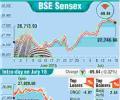
The S&P BSE Sensex dipped 90 points to end at 27,747, after hitting an intra-day high of 28,014.
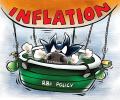
Reserve Bank on Wednesday said it expects retail inflation at 5.2 per cent in the first half of the current fiscal and revised downwards the target to 5 per cent for the quarter ended March. While headline inflation at 5 per cent in Feb 2021 remains within the tolerance band, some underline constituents are testing the upper tolerance level. Going forward, the food inflation trajectory will critically depend on the temporal and special progress of southwest monsoon in the 2021 season, RBI Governor Shaktikanta Das said on Wednesday while announcing the first monetary policy for the current fiscal. Reserve Bank of India (RBI) has kept the key repo rate unchanged at 4 per cent to support growth in the current situation.

The S&P BSE Sensex ended up 134 points at 27,279 and the Nifty50 ended up 42 points at 8,371.

As much as 46 per cent of the respondents in India are looking to travel in October-December, even as only six per cent of them have made bookings, indicating that most of them may look either for last-minute deals or opt for a road journey, as per a survey. The survey, conducted by the online platform LocalCircles, also revealed that the festive season (October-December) is likely to see a 60 per cent jump in citizens travelling as compared to the monsoon season (August-September). About 34 per cent of respondents said they are planning to visit family and friends in October-December.

Kerala has retained the top rank in Niti Aayog's SDG India Index 2020-21, while Bihar has been adjudged as the worst performer, according to a report released on Thursday. The Index for Sustainable Development Goals (SDGs) evaluates progress of states and union territories on social, economic and environmental parameters. Kerala retained its rank as the top state with a score of 75. Both Himachal Pradesh and Tamil Nadu took the second spot with a score of 74. Bihar, Jharkhand and Assam were the worst performing states in this year's India index.

Over to the government how they manage the uncertainty of monsoon and revive spending in order to entice RBI for another round of rate cuts

Dubbing the United Progressive Alliance at the Centre as "the most corrupt government ever seen by independent India", senior Bharatiya Janata Party leader L K Advani on Saturday wanted the Lokpal bill to be passed in the next session of Parliament itself.

Critics of Hindi cinema are a disparate, colourful, bunch that evoke much derision and tut-tut among its own tribe, but Chup's distant understanding of their influence and idiosyncrasies fails to give the loathing any real impact, notes Rediff.com Principal Movie Critic Sukanya Verma.

With satisfactory progress of monsoon rainfalls prompting farmers to bring in additional area under basmati sowing, prices are set to fall lower going forward.

The aim of the programme is to increase the water table in the stressed areas through dams, ponds, and afforestation. According to a NITI Aayog study, by 2030, the country's water demand is projected to be twice the available supply, implying severe water scarcity for hundreds of millions of people and an eventual 6 per cent loss in the country's GDP.

Analysts said the demand recovery in two-wheeler and car segments was skewed towards the semi-urban and rural markets.
'There is a weak link between the economy and the stock market.'

Indian consumers are likely to get respite from rising prices just before the festival season. Some consumer companies, including automakers, have indicated that they are planning to pause price hikes just before demand picks up in August, while keeping a close eye on volatile raw material prices.
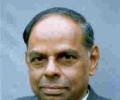
The Reserve Bank in its first mid-quarter policy review on Monday kept the key interest rates unchanged because of elevated food inflation, rupee depreciation and uncertainty over foreign fund inflows.

Days after Herwad village in Maharashtra's Kolhapur district passed a resolution to ban the customs associated with widowhood to maintain women's "right to live with dignity", those spearheading the campaign are now following up with the state government, demanding that a law be framed to end the "regressive" traditions.

'Over the next two quarters, markets will be guided by observing the earnings resilience of corporates during the second lockdown, progress of the monsoon and the damage, if any, to rural spending power due to the second wave.'

Progress of monsoon, investment trend by foreign investors and the movement of rupee against the dollar will also influence sentiment

Sowing of kharif crops begins with the onset of southwest monsoon from June, while harvesting starts from October. Rice is the main kharif crop, besides bajra, arhar, urad, moong, groundnut and soyabean.
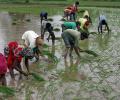
The sowing area under pulses went up by 7 per cent to 132.56 lakh hectare, against 124.15 lakh hectare area.
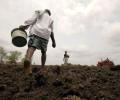
Till June 30, the southwest monsoon was 33 per cent lower than normal, which is among the worst in the last five years, with 28 of the 36 meteorological divisions recording deficient rain.
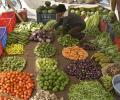
In most cases, however, retail consumers are paying higher prices in the absence of direct procurement from aggregator or farmers.

"Border skirmishes have been rising and people are dying... A way has to be found to deal with this. Except for talks... As you are talking to China to attempt that it withdraws (from Ladakh border), we should also talk to our (other) neighbour to find a way to get out of this situation," he said in Lok Sabha during the Zero Hour amid protests from treasury benches.
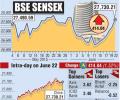
The 30-share Sensex surged 414 points to end at 27,730.

RBI Governor Shaktikanta Das said that early containment of the pandemic could impart an "upside" to the economic growth outlook.
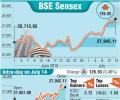
The S&P BSE Sensex rose 127 points to end at 27,942.

RIL was the biggest gainer in the Sensex pack, rising 2.63 per cent, followed by NTPC, Axis Bank, Tata Steel, PowerGrid, HDFC twins, Bharti Airtel, M&M, ICICI Bank, SBI and Bajaj Finance -- gaining up to 2.51 per cent.

Though agriculture ministry officials are confident of a bumper harvest due to record increase in kharif acreage, experts and farmers said the on-ground situation in some crops is not that encouraging as incessant rains since the last few weeks and pest attack could impact the final yield.
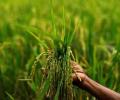
However, the estimates could change in the coming months, as full impact of excess rainfall and floods on the standing soybean and urad crops in central and western India in late August and September has not yet been fully taken into account.
India has not reached the drought situation yet, although it faces the challenge of maintaining record foodgrains production due to weak monsoons this year, Agriculture Minster Sharad Pawar said on Monday.
The frenetic activity currently being witnessed in the Congress combined with the United Progressive Alliance government's move to postpone the monsoon session of Parliament till end-August has once again fuelled speculation about the possibility of an early election, says Anita Katyal.

'When Covid first struck, the lockdown resulted in clean air in major Indian cities.' 'You were able to see the Himalayan range from Ludhiana.' 'In Delhi, you were seeing deer and stags all over the city because there was no traffic.' 'It was incredible. Nature was waiting to come back.'
 © 2026 Rediff.com - Advertise with us - Disclaimer - Privacy Policy - Sitemap - Feedback - About us - Terms of use - Grievances